Best POS Systems for Franchises


Operators Daily is where multi-unit restaurant and hourly-workforce operators get smart, fast — practical guides and no-nonsense software comparisons across hiring, onboarding, scheduling, payroll, and compliance.
Popular articles
Running a multi-location franchise without a centralized POS system is like managing a restaurant chain through spreadsheets and phone calls. You need real-time visibility across every location, centralized menu control, and automated reporting to scale effectively. The right point of sale system connects your operations, from employee scheduling to inventory tracking, while giving franchisors the oversight they need.
This guide breaks down the 10 best POS systems for franchises in 2026, covering features, pricing, and the specific capabilities that matter for multi-unit restaurant operations.
Key Takeaways
- Toast reports 180,000 locations and 300+ integration partners, combining native restaurant products with third-party integrations.
- Square offers a low barrier to entry with a $0/month Free plan and no long-term contracts.
- Larger franchise systems should evaluate NCR Aloha, Revel Systems, or Oracle MICROS Simphony.
- Multi-location management and centralized reporting are core franchise requirements. Royalty calculation and collection often require a POS add-on, such as KORONA's Franchise add-on, a franchise management platform, or an integration, so confirm how each vendor handles them.
- Total cost of ownership over 36 months matters more than monthly subscription fees when comparing options.
What is a POS System and Why is it Critical for Franchises?
A point of sale system processes transactions and serves as the operational hub for restaurant data. For single-location restaurants, basic transaction processing might suffice. Franchises require something fundamentally different.
Multi-unit operators need centralized control over menus, pricing, and promotions across all locations. They need consolidated reporting that shows performance comparisons between units. Most critically, they need data synchronization that happens in real time, not through manual exports and spreadsheet reconciliation.
The franchise POS market reflects this demand. RestaurantData's Spring 2025 survey of chains with five or more locations in the US and Canada found that Aloha/NCR had the largest reported installed base, at 65,079 surveyed locations and a 22.68% share. The same survey reported that the number of surveyed chains using Micros/Oracle grew 58% from Fall 2024, with 34,190 surveyed locations.
For franchise operators, the right POS delivers:
- Centralized menu management that pushes changes to all locations simultaneously
- Multi-location dashboards comparing sales, labor, and inventory across units
- Royalty support through a POS add-on, franchise management platform, or integration, depending on the vendor
- Standardized operations ensuring consistency across the brand
Key Features to Look for in a Franchise Restaurant POS System
Streamlined Inventory Management Across Multiple Locations
Inventory tracking at the franchise level requires more than basic stock counts. Lightspeed Restaurant documents ingredient-level tracking that depletes specific ingredients as menu items sell. When a franchisee sells a margherita pizza, the system adjusts flour, tomatoes, and mozzarella inventory based on the configured recipe.
This granularity enables:
- Waste reduction through accurate usage tracking
- Recipe costing for each menu item
- Low-stock alerts and recurring supplier orders
- Menu engineering reports showing which items deserve menu space
Franchises that distribute ingredients through a central commissary should confirm commissary management capabilities separately with each vendor.
Robust Reporting and Analytics for Franchise Performance
Franchise reporting needs go beyond individual location P&L statements. Operators need cross-location comparisons, trend analysis, and the ability to identify underperforming units quickly.
Toast reports 300+ integration partners that connect POS data with accounting, payroll, and business intelligence tools. Its Toast IQ assistant provides conversational insights into restaurant performance without requiring manual report building.
KORONA POS offers franchise reporting through its Franchise add-on, which includes royalty rules and royalty reporting along with product syncing and central inventory.
Comparing Top POS Systems for Multi-Unit Restaurant Franchises
We evaluated each platform based on multi-location management, franchise-specific tools, published pricing and contract terms, and integration options. Here are the top options for franchise operators.
1. Toast POS
Best for: Full-service franchises planning to expand
Toast offers native payroll, online ordering, and kitchen display systems within one restaurant ecosystem, along with third-party integrations through its marketplace. Toast's website reports that its customers have 47% higher average revenue than the US restaurant average; this is a correlation published by Toast, not evidence that the software caused the difference.
Key Features
- Multi-location management with centralized menu control and real-time sync
- Toast KDS hardware rated for temperatures up to 120°F
- Cellular failover with compatible hardware, subject to cellular reception and configuration
- Native products and third-party integrations, with compatibility and fees confirmed individually
Price
Starter Kit at $0/month with pay-as-you-go processing; Point of Sale plan at $69/month. Processing rates and contract length depend on the selected package and order form.
Strengths
- Broad restaurant ecosystem with native payroll, online ordering, and KDS
- 300+ integration partners
- Toast IQ conversational insights
Limitations
- Contract terms are set in the individual order form
- Add-ons increase monthly costs
- Third-party integrations may carry separate fees
2. Square for Restaurants
Best for: Emerging franchises prioritizing flexibility and value
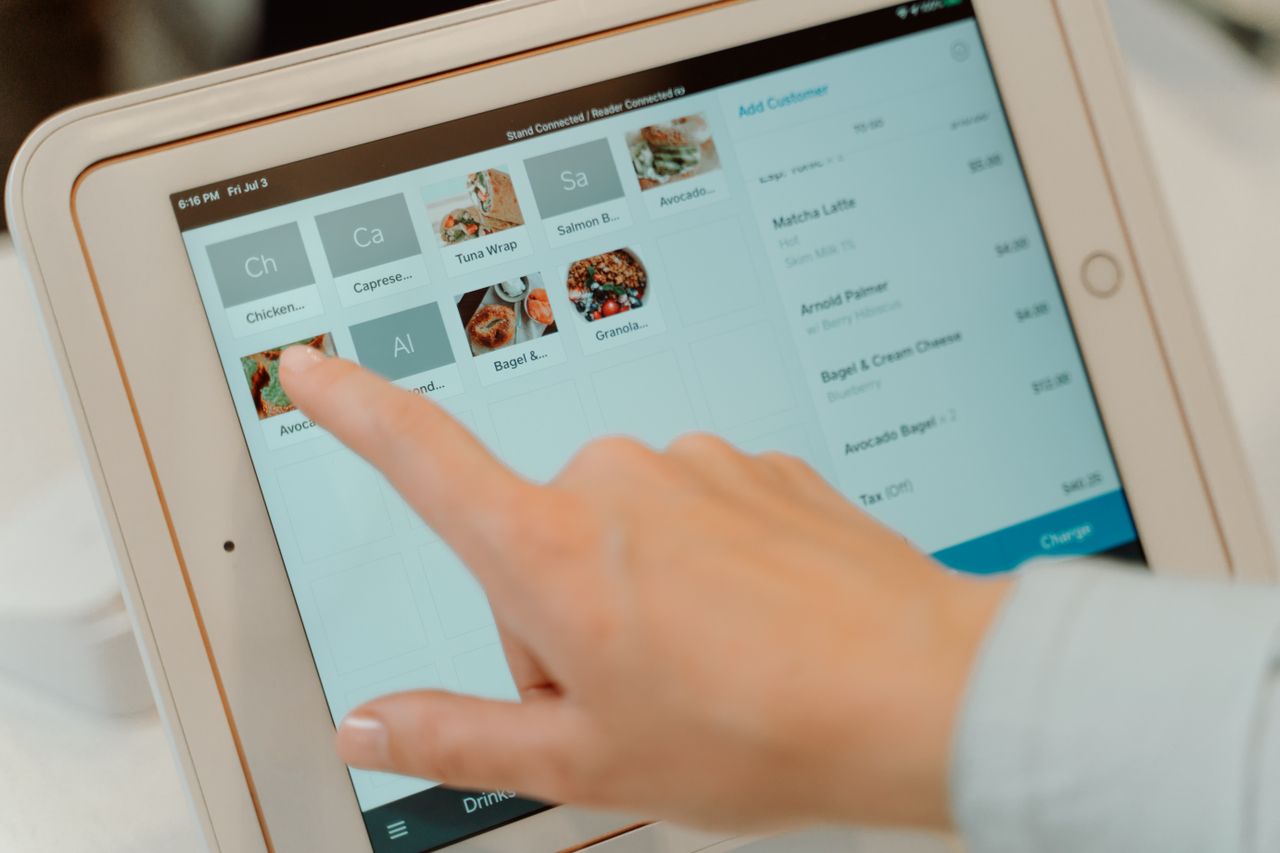
Square for Restaurants offers an iPad-native interface, no long-term contracts, and multi-location support with cross-location loyalty and gift cards.
Key Features
- No contracts, with the ability to upgrade or cancel anytime
- Multi-location support with cross-location loyalty and gift cards
- iPad-native interface
Price
Free at $0/month (2.6% + 15¢); Plus at $49/month per location (2.5% + 15¢); Premium at $149/month per location (2.4% + 15¢), at standard card-present rates.
Strengths
- $0/month entry plan
- No long-term contracts
- Published pricing
Limitations
- Shallower reporting than enterprise franchise platforms
- Free plan processing is higher than on paid plans
- Royalty management requires a separate solution
3. Lightspeed Restaurant
Best for: Franchises that need ingredient-level inventory control
Lightspeed Restaurant documents ingredient depletion as items sell, recipe costing, low-stock alerts, and recurring supplier orders.
Key Features
- Ingredient-level inventory depletion and recipe costing
- Low-stock alerts and recurring supplier orders
- Multi-location management
Price
Starter at $69/month, Essential at $189/month, and Premium at $399/month. Advanced inventory is available as an add-on; contract terms require inquiry.
Strengths
- Detailed ingredient and recipe tracking
- Published, tiered pricing
- Supplier ordering tools
Limitations
- Advanced inventory adds to the base price
- Central commissary management should be confirmed separately
- Contract terms are not published
4. TouchBistro
Best for: Small franchise units wanting modular pricing
TouchBistro offers modular add-on pricing where franchises pay only for the features they use.
Key Features
- Modular add-ons for reservations, online ordering, and loyalty
- iPad-based POS
- Payment options (confirm compatibility with your processor)
Price
POS plans start at $69/month. Contract length and supported payment-processing arrangements depend on the sales quote and configuration; reservations, online ordering, and loyalty cost extra and require a quote.
Strengths
- Pay only for the modules you need
- iPad-based interface
Limitations
- Initial term is set in the sales quote, with automatic renewal and early termination restrictions
- Add-on pricing requires a quote
5. KORONA POS
Best for: Franchisors that want built-in royalty rules and processor flexibility
KORONA POS offers a Franchise add-on with royalty rules, royalty reporting, product syncing, central inventory, and custom taxes and currencies. KORONA describes itself as processing agnostic, so franchises can keep their current processor or choose another.
Key Features
- Royalty rules and royalty reporting through the Franchise add-on
- Product syncing and central inventory
- Custom taxes and currencies
- Processing-agnostic setup
Price
Core at $59 per terminal per month; Franchise add-on at $30 per franchisee per month. KORONA lists no forced contracts and discounts annual plans.
Strengths
- Royalty tools available without a separate franchise platform
- Freedom to choose a payment processor
- No forced contracts
Limitations
- Per-terminal and per-franchisee fees add up across large systems
- General support runs on business hours, with 24/7 coverage limited to emergencies
6. SpotOn
Best for: Franchises that want offline KDS routing and fast menu updates
SpotOn offers an AI Menu Assistant that supports prompt-based bulk changes to prices, descriptions, categories, modifiers, and menu items. Its offline mode supports local order entry and KDS routing while devices remain connected through the local network.
Key Features
- AI Menu Assistant for prompt-based bulk menu changes
- Offline order entry and KDS routing over the local network; online orders do not reach the POS or KDS during an outage, and offline cards cannot be validated immediately
- Build Your Own offering with custom processing rates
Price
All-In at $0/month (2.79% + 20¢) with processing minimums and a two-year minimum term; POS Essentials at $55/station per month, month-to-month (2.45% + 15¢, with American Express at 3.19% + 15¢). Custom rates are available through Build Your Own.
Strengths
- Fast, prompt-based menu management
- Offline KDS routing on the local network
- Choice of plan structures
Limitations
- All-In requires a two-year minimum term and processing minimums
- Online orders pause during internet outages
7. Clover
Best for: Franchises wanting subscription hardware with $0 down
Clover offers subscription hardware options with $0 down and multiple hardware configurations.
Key Features
- Subscription hardware with $0 down
- Multiple hardware configurations
- App marketplace for customization
Price
Pricing varies by bundle, hardware, contract term, and seller. Clover states that equipment subscriptions are noncancelable and ineligible for refunds, subject to specified buyout and upgrade arrangements.
Strengths
- Low upfront hardware cost
- Range of hardware form factors
Limitations
- Equipment subscriptions are noncancelable
- Different hardware setups across franchisees increase training complexity
8. NCR Aloha
Best for: Established franchise systems with large installed bases
NCR Voyix offers Aloha Cloud, an Android-based product, and Aloha Essentials, which includes the Windows-based Aloha POS. Aloha/NCR had the largest reported installed base in RestaurantData's Spring 2025 survey of chains with five or more locations.
Key Features
- Aloha Cloud (Android-based) and Aloha Essentials (Windows-based Aloha POS)
- Enterprise multi-location management
- Long track record in chain restaurants
Price
Custom, enterprise-focused pricing; confirm pricing for the specific Aloha product.
Strengths
- Large installed base among chains
- Choice between cloud-based and Windows-based products
Limitations
- Features and hardware differ between Aloha products
- Pricing not published for enterprise configurations
9. Revel Systems
Best for: Franchises pushing menu changes from corporate to all locations
Revel Systems is an enterprise iPad POS that pushes menu changes from corporate to all locations and offers an API for connecting with other systems.
Key Features
- Centralized menu changes from corporate to all locations
- Enterprise multi-location reporting
- API for integrations with franchise systems
Price
Custom enterprise pricing; confirm implementation fees and contract term.
Strengths
- Corporate control over menus across locations
- Enterprise reporting
Limitations
- Confirm tax configuration capabilities for each jurisdiction
- Confirm a named, supported connector before assuming a ready-made franchise management integration
10. Oracle MICROS Simphony
Best for: Large franchise and hospitality groups
Oracle MICROS Simphony is an enterprise POS with hospitality integrations. Demand forecasting is available through additional Oracle solutions rather than the standard Simphony subscription.
Key Features
- Enterprise multi-location operations
- Hospitality integrations
- Demand forecasting through additional Oracle solutions
Price
Custom enterprise pricing; confirm which products and licenses are required.
Strengths
- Built for large multi-location groups
- Hospitality integrations
Limitations
- Demand forecasting requires additional Oracle products
- Complex implementation and unpublished pricing
Cost Analysis: Finding the Cheapest POS System for Your Restaurant Franchise
Understanding Different POS Pricing Structures
POS pricing breaks down into four components: software subscriptions, hardware costs, payment processing fees, and implementation/training expenses.
POS System Pricing Comparison:
- Square: $0/month starting price, 2.4-2.6% + 15¢ standard card-present processing, no contract required
- Toast: $0/month starting price, processing rates and contract term set in the order form
- Lightspeed: $69/month starting price, contract terms by inquiry
- TouchBistro: $69/month starting price, contract length and payment arrangements set in the sales quote
- KORONA POS: $59 per terminal/month + $30 per franchisee/month for the Franchise add-on, processing agnostic, no forced contracts
- SpotOn: $0/month All-In plan (2.79% + 20¢, two-year minimum term, processing minimums); $55/station Essentials plan (2.45% + 15¢, month-to-month); custom rates through Build Your Own
Factors Influencing the Total Cost of Ownership
The cheapest monthly subscription often becomes expensive over three years when factoring in processing fees, required add-ons, and hardware costs.
KORONA POS is processing agnostic, allowing franchises to keep their current processor or shop for a better rate. That flexibility can matter for high-volume locations comparing processing offers.
Clover requires attention to contract terms. While the platform offers subscription hardware options with $0 down, Clover states that equipment subscriptions are noncancelable and ineligible for refunds, subject to specified buyout and upgrade arrangements.
POS System Software for Small Business Franchises: What to Consider
Balancing Simplicity and Scalability for Small Franchise Units
Emerging franchises face a tension between affordability today and scalability tomorrow. A system that works for 3 locations may struggle at 15.
TouchBistro offers modular add-on pricing where franchises pay only for features they use. POS plans start at $69/month, with reservations, online ordering, and loyalty available as additional-cost products that require a quote.
SpotOn's offline mode supports local order entry and KDS routing while devices remain connected through the local network, though online orders do not reach the POS during an outage. Its AI Menu Assistant speeds up menu building through prompts rather than manual entry.
Free vs. Paid POS Solutions for Emerging Franchises
Square's free tier removes financial barriers for new franchises testing concepts. However, free plans typically include higher processing rates that offset subscription savings at volume.
The breakeven point matters. Compare total costs at your own sales volume, since the point where a paid plan or a deeper feature set pays for itself varies by location and card mix.
When evaluating your overall technology stack, consider how POS integrates with workforce management software for labor cost tracking and scheduling optimization.
Integrating POS with Franchise Management Software Like FranConnect
The Benefits of a Unified Franchise Technology Stack
Franchise management platforms like FranConnect handle territory management, compliance monitoring, franchisee communications, and royalty management. When these systems integrate with POS data, franchisors can gain:
- Royalty calculations based on actual sales
- Real-time compliance monitoring for operational standards
- Consolidated reporting across all franchise technology
- Streamlined auditing with connected data sources
Calculating royalties and collecting royalty payments are separate functions, so confirm which system handles each. Revel offers an API, and Toast reports 300+ integration partners, but confirm a named, supported connector with your franchise management platform before assuming a ready-made integration.
Ensuring Seamless Data Exchange Between Systems
Integration quality varies significantly. Native integrations built by the POS vendor typically offer deeper functionality than third-party connectors.
Before committing, verify:
- Does the integration sync in real time or batch daily?
- Which data fields transfer between systems?
- What happens when the integration fails mid-service?
- Who provides support for integration issues?
Essential Training for Franchise POS System Implementation
Developing a Comprehensive POS Training Program for New Franchisees
POS training directly impacts franchisee success. When your team is bringing on new locations, consider how onboarding connects with POS training to create consistent experiences across units; our guide to employee onboarding best practices covers the platforms involved.
Effective franchise POS training programs include:
- Train-the-trainer models where corporate trains location managers who then train staff
- Role-based modules covering servers, managers, and back-office functions separately
- Certification requirements before new locations open
- Ongoing refresher training when features update
Leveraging Vendor Resources for Effective Staff Onboarding
Vendor support quality varies. KORONA POS includes business-hours phone, email, and chat support (Monday through Friday, 6 a.m. to 6 p.m. Pacific), plus 24/7 emergency support for critical sales issues. Ask each vendor whether multi-location accounts include dedicated account management.
Clover offers multiple hardware configurations, which increases training complexity when franchisees use different setups. Standardizing hardware across locations simplifies training and troubleshooting.
Future-Proofing Your Franchise with a Modern POS System
The Advantages of Cloud-Based POS for Scalable Franchises
Cloud-based systems dominate modern franchise operations for good reason. Updates deploy automatically across all locations. Data syncs in real time. Remote management becomes possible from anywhere.
Market data shows enterprise platforms gaining ground among chains. RestaurantData's Spring 2025 survey reported 58% growth in the number of surveyed chains using Micros/Oracle since Fall 2024, and Toast reports 180,000 locations on its website.
Adapting to Emerging Payment Technologies
Modern POS systems must handle:
- Contactless payments and mobile wallets
- QR code ordering and payment
- Gift card and loyalty program integration
- Split payments and tip adjustments
Toast offers cellular failover with compatible hardware and cellular reception. SpotOn's offline mode keeps local order entry and KDS routing running over the local network, although online orders pause and offline cards cannot be validated immediately. Neither guarantees uninterrupted service in every outage.
For franchises planning international expansion, evaluate currency handling, tax compliance across jurisdictions, and language support for both staff and customer-facing interfaces.
The Bottom Line
Franchise POS decisions come down to how much control the franchisor needs and how many units the system has to support. Growing full-service brands can look at Toast's ecosystem, while emerging franchises that want low commitment can start with Square. Franchisors that want royalty rules inside the POS can evaluate KORONA's Franchise add-on, inventory-focused brands can consider Lightspeed, and SpotOn, TouchBistro, and Clover offer different trade-offs on menu tools, modular pricing, and hardware. Larger systems with established chain operations have enterprise options in NCR Aloha, Revel, and Oracle MICROS Simphony.
Before standardizing on a platform, model three-year costs for one typical franchisee, including per-terminal, per-location, and per-franchisee fees, processing rates, and contract terms. Confirm in writing how royalties will be calculated and collected, and which franchise management connectors are actually supported.
For a wider view of the market, see our guide to the best restaurant POS systems.
Frequently Asked Questions
What is the difference between a POS system for a single restaurant and one for a franchise?
Single-location POS systems focus on transaction processing and basic reporting. Franchise POS platforms add centralized menu management, multi-location dashboards, and the ability to push operational changes across all units simultaneously. Royalty calculation may come from a POS add-on, such as KORONA's Franchise add-on, a franchise management platform, or an integration.
Can I use the same POS system across all my franchise locations?
Yes, and consistency provides significant advantages. Standardized POS across locations simplifies training, enables accurate cross-location comparisons, and ensures data integrity for franchise reporting. Many franchise agreements require approved POS systems to maintain operational standards.
What are the typical costs associated with implementing a POS system for a franchise?
Costs vary widely based on system choice and scale. Entry-level options like Square start at $0/month with higher processing fees. Mid-market solutions like Toast and Lightspeed range from 69-399/month per location, and KORONA charges per terminal plus per franchisee for its Franchise add-on. Enterprise systems require custom quotes, so ask for implementation, training, and ongoing support fees in writing.
How important is integration with other restaurant technologies for a franchise POS?
Critical. Your POS should connect with accounting software, payroll systems, online ordering platforms, and loyalty programs. Toast reports 300+ integration partners through its marketplace. Lack of integration creates manual data entry, reconciliation errors, and operational inefficiencies that compound across multiple locations.
What kind of support should I expect from a POS vendor for my multi-unit franchise?
Franchise accounts should ask about dedicated account management, priority support queues, and assistance with multi-location rollouts. KORONA POS, for example, provides business-hours phone, email, and chat support plus 24/7 emergency support for critical sales issues. Verify support availability, response time guarantees, and whether support covers both software and hardware issues before signing contracts.
Join multi-unit operators getting practical guides and no-nonsense software breakdowns across hiring, onboarding, scheduling, payroll, compliance, and what's shifting in the industry.
Free. One email a week. Unsubscribe anytime.